About the Data
Species records include data on invasions history, distribution, ecology, impact, and more. These data were gathered from published literature and targeted surveys. All records have undergone expert review, unless otherwise noted.
Species Profiles
NEMESIS includes detailed information on about 500 species of marine and estuarine of invertebrates and algae introduced to the United States. Each record contains information on taxonomy, distribution, ecology, and impacts, as well as references.
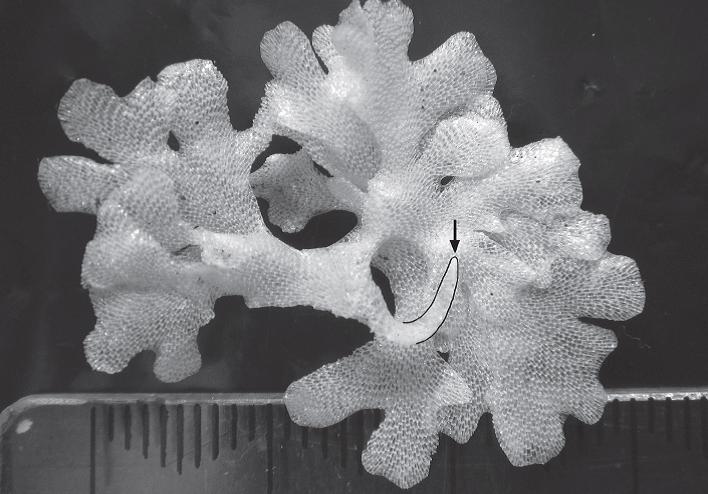
Membraniporopsis tubigera
Membraniporopsis tubigerum initially forms encrusting, circular colonies, but as it grows it produces erect, lightly calcified two-layered fronds. It was first described from Florida, Texas and Puerto Rico, but as suggested by other authors, we suspect that it may be native to the Northwest Pacific where it was reported from the Sea of Japan, Russia. Introduced populations have been reported in Uruguay, Brazil, Australia and New Zealand. The preferred habitat of M. tubigerum is unclear – it has been found on fouling plates and on algal fronds, but is most often seen in immense drifts washing ashore on sandy beaches. In New Zealand and South America, this species can clog fishing nets and disturb the aesthetic of recreational beaches when it washes up in large, smelly masses.
Daily Invader for 2026-08-21