Invasion History
Panama Invasion History:
Invasion history elsewhere in the world:
While Procambarus clarkii has been widely introduced around the world, P. zonangulus has, so far, only been reported from the Nile River, Egypt (Ibrahim et al. 1997, cited by Holdich et al. 2010). It is likely that it will be found in other locations where crayfish are cultured, or have been released as food.
Description
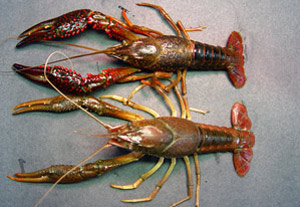
Procambarus zonangulus has an ovoid carapace and chelae (claws) covered with tubercles and granules. It has a prominent rostrum, which is strongly triangular with a median keel and a pointed tip. The two halves of the carapace are separated by a gap, whereas they join in P. clarkii. The chelae are somewhat narrow, cylindrical, and elongated, with a large gap at the base of the movable finger. The carpus or wrist joint bears three spines, one very large, on its interior edge. In the males, the 3rd segment (ischia) of the 3rd pair of walking legs bears copulatory hooks. The annulus ventralis (seminal receptacle) of the female is an ovoid structure located between the 4th and 5th pair of walking legs, with a sigmoid (a groove running across the center), and two groups of tubercles at the anterior border. Young Southern White River Crayfish are sandy-white, with black spots on the head, body, and tail. The adults are light brown, with a wide black stripe on the dorsal surface of the tail (Huner and Barr 1991). These crayfish mature at ~30 mm carapace length (~60 mm total length) and frequently reach 50 mm (100 mm, total length, Deng et al. 1993). The largest reported specimen was 178 mm total length (Huner and Barr 1991).
Procambarus zonangulus is a member of the Procambarus acutus species complex, consisting of several similar species in the Mississippi-Gulf Basin and Atlantic drainages, whose systematics are still unresolved (Hobbs and Hobbs 1990; Kilian et al. 2010; Huner and Parr 1991). Separation of P. zonangulus from East Coast native P. acutus acutus requires microscopic examination of 1st form male gonopods, and the interspecific differences are subtle.
Taxonomy
Taxonomic Tree
| Kingdom: | Animalia | |
| Phylum: | Arthropoda | |
| Subphylum: | Crustacea | |
| Class: | Malacostraca | |
| Subclass: | Eumalacostraca | |
| Superorder: | Eucarida | |
| Order: | Decapoda | |
| Suborder: | Pleocyemata | |
| Infraorder: | Stenopodidea | |
| Superfamily: | Astacoidea | |
| Family: | Cambaridae | |
| Genus: | Procambarus | |
| Species: | zonangulus |
Synonyms
Potentially Misidentified Species
P. acutus acutus (White River Crayfish) is a species complex, which includes at least 3 species of crayfishes in the eastern United States. One form is native to Atlantic drainages from Georgia to New Jersey, while the others are native to the Mississippi Basin (Hobbs and Hobbs 1990; Huner and Barr 1991; Taylor et al. 1996).
Procambarus clarkii
Procambarus clarkii (Red Swamp Crayfish) is a widely cultured food item, usually occurring in its native range and often in cultured populations with P. zonangulus. Both species are frequetly lumped together (Huner and Barr 1991; Deng et al. 1993).
Ecology
General:
Life History: Procambarus zonangulus frequently co-occurs with P. clarkii (Red Swamp Crayfish), and is often lumped with it in ecological and aquaculture studies (Niquette and Dabrano 1991; Huner and Barr 1991). They are considered a 'tertiary burrowing' crayfish (primary burrowers burrow year-round, secondary burrowers leave the burrow during rainy periods, and tertiary burrowers inhabit the burrow during the breeding season and during droughts, but are found in open water the rest of the year). Freshwater crayfishes, of the family Cambaridae, mate by internal fertilization, with the male inserting pleopods into the females seminal (annulus ventralis) between the 4th and 5th walking legs. The female curls her abdomen far forward to create a chamber in which the eggs are driven by the pleopods. The mass of eggs becomes attached under the tail. Larval development takes place inside the egg and the young hatch as miniature adults (Barnes 1983).
Male cambarid crayfish show sharp morphological changes with season. At the start of the breeding season, they molt into a sexually competent stage (Form I), marked by lengthening and stiffening of the modified 1st pleopods, more pronounced ischial spines (in the basal segments of the 3rd walking leg) and enlarged chelipeds. After breeding, the crayfish molts back into Form II, with the 1st pleopods less differentiated and soft ischial spines reduced, and less robust chelipeds (Hobbs 1989).
Ecology: Procambarus zoangulus constructs burrows near the water's edge which are usually under 0.5 m in length, but may extend to 4.5 m depending on soil and moisture conditions. Burrows are often partly filled with water, but crayfish are frequently out of the water because of low oxygen concentrations (Correia and Ferreira 1995; Huner and Barr 1984). Overland movements may occur in response to heavy rains, flooding, or anoxia in burrow water (Huner 1989). In the early part of its life, it is found in deeper water (up to two or three feet) in marsh lagoons. As it attains maturity, and the spawning season approaches, it migrates to the shallow water of open marshes (usually less than six inches deep). Culture ponds are usually 0.3-0.7 m deep (Huner and Barr 1991). Procambarus zonangulus, like P. clarkii, tolerates salinities of 20-30 PSU (Huner and Barr 1991; Newsom and Davis 1994). Both Procambarus spp. are omnivorous, but in Texas sloughs, female P. zonangulus consumed more animal food than P. clarkii (Deng et al. 1993). The presence of Blue Crabs (Callinectes sapidus) likely restricts the occurrence of Southern White River Crayfish in East coast estuaries (Huner and Barr 1991).
Food:
detritus; carrion; vascular plants; invertebrates
Consumers:
Fish, birds, mammals, crabs
Competitors:
Other crayfish species
Trophic Status:
Omnivore
OmniHabitats
| General Habitat | Fresh (nontidal) Marsh | None |
| General Habitat | Grass Bed | None |
| General Habitat | Coarse Woody Debris | None |
| General Habitat | Nontidal Freshwater | None |
| General Habitat | Tidal Fresh Marsh | None |
| General Habitat | Salt-brackish marsh | None |
| General Habitat | Unstructured Bottom | None |
| General Habitat | Rocky | None |
| General Habitat | Oyster Reef | None |
| Salinity Range | Limnetic | 0-0.5 PSU |
| Salinity Range | Mesohaline | 5-18 PSU |
| Vertical Habitat | Endobenthic | None |
| Vertical Habitat | Epibenthic | None |
Tolerances and Life History Parameters
| Minimum Temperature (ºC) | 0 | Prcambarus 'can live just about anywhere so long as the water in their burrows does not freeze' (Huner and Barr 1991). |
| Maximum Temperature (ºC) | 35 | Huner and Barr 1991 |
| Minimum Salinity (‰) | 0 | This is a freshwater species, |
| Maximum Salinity (‰) | 20 | Huner and Barr 1991; Newsom and Davis 1994 |
| Minimum pH | 5.8 | Huner and Barr 1991 |
| Maximum pH | 10 | Huner and Barr 1991 |
| Minimum Reproductive Temperature | 15 | Huner and Barr 1991 |
| Maximum Reproductive Temperature | 28 | Huner and Barr 1991 |
| Minimum Reproductive Salinity | 0 | Huner and Barr 1991 |
| Maximum Reproductive Salinity | 12 | Huner and Barr 1991 |
| Minimum Length (mm) | 60 | Total length at 1st reproduction (Deng et al. 1993) |
| Maximum Length (mm) | 178 | Huner and Barr 1991 |
| Broad Temperature Range | None | Warm-temperate |
| Broad Salinity Range | None | Limnetic-Mesohaline |
General Impacts
No ecological impacts have been reported for Procambarus zonangulus. However, its introduced population has only been surveyed in Maryland (Kilian et al. 2010; USGS Nonindigenous Aquatic Species Program 2017). Potential impacts are probably similar to those of P. clarkii, including burrowing, destruction of aquatic vegetation, and competition with native crayfishes.Regional Distribution Map
| Bioregion | Region Name | Year | Invasion Status | Population Status | Vectors |
|---|
Occurrence Map
| OCC_ID | Author | Year | Date | Locality | Status | Latitude | Longitude |
|---|
References
Associated Press November 24, 1986 Farmers raising crawfish: Maryland goes Cajun. <missing URL>Blank, Grant S.; Figler, Michael H. (1996) Interspecific shelter competition between the sympatric crayfish species Procambarus clarkii (Girard) and Procambarus zonangulus (Hobbs and Hobbs), Journal of Crustacean Biology 16(2): 300-309
Deng, Xuehuai; Bechler, David L.; Lee, Kwan R. (1993) Comparative life history studies of two sympatric Procambarus crawfish, Journal of Shellfish Research 12(2): 343-350
Harrell, Reginal M. (1987) <missing title>, University of Maryland Sea Grant, College Park. Pp. <missing location>
Hobbs, Horton H., Jr.; Hobbs, H. H., III (1990) New crayfish (Decapoda: Cambaridae) from southeastern Texas, Proceedings of the Biological Society of Washington 103(3): 608-613
Huner, J. V.; Barr, J. E. (1991) <missing title>, Louisiana Sea Grant Program, Sea Grant College, Louisiana State University, Baton Rouge. Pp. <missing location>
Kilian, Jay V. and 6 authors (2010) The status and distribution of Maryland crayfishes, Southeastern Naturalist 9(Special Issue 3): 11-32
Newsom, James E.; Davis, Kenneth B. (1994) Osmotic response of haemolymph in red swamp crayfish (Procambarus clarkii) and white river crayfish (P. zonangulus) to changes in temperature and salinity, Aquaculture 126: 373-381
Niquette, Daniel J., D'Abramo, Louis R. (1991) Population dynamics of red swamp crawfish, Procambarus clarkii (Girard, 1852) and white river crawfish, P. acutus acutus (Girard, 1852), cultured in earthen ponds, Journal of Shellfish Research 10(1): 179-186
Taylor, Christopher A.; Warren, Melvin L.; Fitzpatrick, J. F., Jr., Hobbs, Horton H.., Jezerinac, Raymond F., Pflieger, William L., Robison, Henry W. (1996) Conservation status of crayfishes of the United States and Canada, Fisheries 21(4): 25-37
Turner, Ruth D.; Boss, Kenneth (1962) The genus Lithophaga in the Western Atlanitc, Johnsonia 4(41): 81-116
USGS Nonindigenous Aquatic Species Program 2003-2026 Nonindigenous Aquatic Species Database. https://nas.er.usgs.gov/