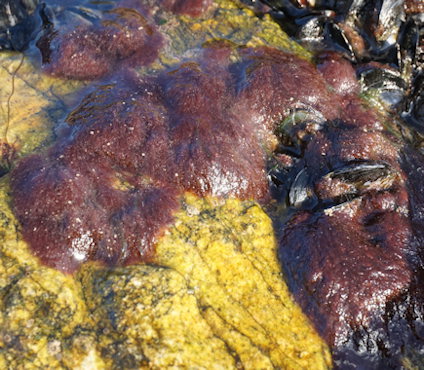
Invasion History
First Non-native North American Tidal Record:First Non-native West Coast Tidal Record:
First Non-native East/Gulf Coast Tidal Record:
General Invasion History:
None
North American Invasion History:
Description
None
Taxonomy
Taxonomic Tree
| Kingdom: | Plantae | |
| Phylum: | Rhodophycota | |
| Class: | Rhodophyceae | |
| Subclass: | Florideophycideae | |
| Order: | Ceramiales | |
| Family: | Rhodomelaceae | |
| Genus: | Polysiphonia | |
| Species: | atlantica |
Synonyms
Polysiphonia macrocarpa (Harvey, 1836)
Potentially Misidentified Species
Ecology
Trophic Status:
Primary Producer
PrimProdHabitats
| General Habitat | Grass Bed | None |
| General Habitat | Mangroves | None |
| General Habitat | Marinas & Docks | None |
| General Habitat | Oyster Reef | None |
| General Habitat | Rocky | None |
| General Habitat | Coarse Woody Debris | None |
| Salinity Range | Polyhaline | 18-30 PSU |
| Tidal Range | Subtidal | None |
| Tidal Range | Low Intertidal | None |
| Vertical Habitat | Epibenthic | None |
Tolerances and Life History Parameters
| Broad Temperature Range | None | Cold temperate-Tropical |
| Broad Salinity Range | None | Polyhaline-Euhaline |
General Impacts
Regional Distribution Map
| Bioregion | Region Name | Year | Invasion Status | Population Status | Vectors |
|---|---|---|---|---|---|
| WA-I | None | 0 | Native | Established | |
| NEA-VI | None | 0 | Native | Established | |
| NEA-V | None | 0 | Native | Established | |
| MED-I | None | 0 | Native | Established | |
| MED-II | None | 0 | Native | Established | |
| MED-III | None | 0 | Native | Established | |
| MED-VII | None | 0 | Native | Established | |
| MED-IV | None | 0 | Native | Established | |
| NEA-IV | None | 0 | Native | Established | |
| NEA-II | None | 0 | Native | Established | |
| NEA-III | None | 0 | Native | Established | |
| CAR-VII | Cape Hatteras to Mid-East Florida | 0 | Native | Established | |
| NA-ET4 | Bermuda | 0 | Native | Established | |
| CAR-I | Northern Yucatan, Gulf of Mexico, Florida Straits, to Middle Eastern Florida | 0 | Native | Established | |
| CAR-II | None | 0 | Native | Established | |
| CAR-III | None | 0 | Native | Established | |
| CAR-IV | None | 0 | Native | Established | |
| CIO-I | None | 0 | Crypogenic | Established | |
| CIO-II | None | 0 | Crypogenic | Established | |
| NWP-4a | None | 0 | Crypogenic | Established | |
| NWP-3a | None | 0 | Crypogenic | Established | |
| AUS-XII | None | 0 | Crypogenic | Established | |
| SEP-H | None | 1971 | Non-native | Established | |
| PAN_PAC | Panama Pacific Coast | 1971 | Non-native | Established |
Occurrence Map
| OCC_ID | Author | Year | Date | Locality | Status | Latitude | Longitude |
|---|
References
Center for Disease Control and Prevention 2019 Cercaroal Dermatitiis. https://www.mayoclinic.org/diseases-conditions/swimmers-itch/symptoms-causes/syc-20355043Cohen, Andrew N. (2006) Bridging divides: Maritime canals as invasion corridors., Springer, Dordrecht, Netherlands. Pp. 127-206
Guiry, M. D.; Guiry, G. M. 2004-2023 AlgaeBase. https://www.algaebase.org/
McCosker, J.E., Dawson, C.E. (1975) Biotic passage through the Panama Canal, with particular reference to fishes, Marine Biology 30: 343-351
South, G. Robin; Tittley, Ian (1986) <missing title>, Huntsman Marine Laboratory and British Museum (Natural History), St. Andrews, New Brunswick, and London. Pp. <missing location>