Invasion History
First Non-native North American Tidal Record:First Non-native West Coast Tidal Record:
First Non-native East/Gulf Coast Tidal Record:
General Invasion History:
None
North American Invasion History:
Description
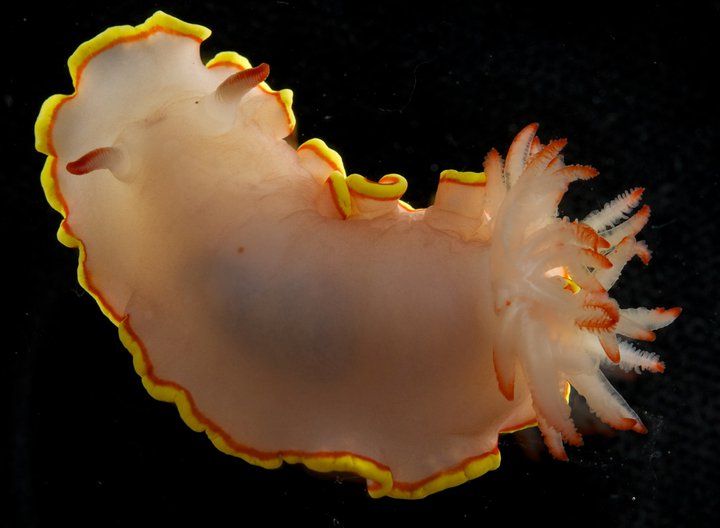
In 1978 and 1983, nudibranchs that were then identified as the tropical Eastern Pacfiic Glossodoris sedna [(Marcus & Marcus 1967) Rudman 1986] were collected in the Bahamas and southern Florida, respectively (Bertsch 1988; Lyons 1989). A recent molecular analysis of the family moved G. sedna to the genus Doriprismatica and found that Atlantic and Pacific populations were genetically distinct species (Johnson and Gosliner 2012). 'Also in this scenario, the specimens identified as D. sedna from the Atlantic and eastern Pacific appear to be distinct species as indicated by COI pairwise distances of 11.7–11.0% between eastern Pacific and Altantic specimens while the three eastern Pacific specimens are 0–0.7% different from each other. This scenario clearly supports vicariance between the Indo-Pacific and eastern Pacific and Atlantic preceding the vicariance between the eastern Pacific and Atlantic.' (Johnson and Gosliner 2012).
Taxonomy
Taxonomic Tree
| Kingdom: | Animalia | |
| Phylum: | Mollusca | |
| Class: | Gastropoda | |
| Subclass: | Opisthobranchia | |
| Order: | Nudibranchia | |
| Family: | Chromodorididae | |
| Genus: | Doriprismatica | |
| Species: | 'sedna' complex |
Synonyms
Chromodoris fayae (Lance, 1968)
Chromolaichma sedna (Bertsch, 1977)
Glossodoris sedna (Rudman, 1986)
Potentially Misidentified Species
Ecology
Food:
Sponges
Trophic Status:
Carnivore
CarnHabitats
| General Habitat | Rocky | None |
| General Habitat | Coral reef | None |
| General Habitat | Grass Bed | None |
| Salinity Range | Polyhaline | 18-30 PSU |
| Salinity Range | Euhaline | 30-40 PSU |
| Tidal Range | Subtidal | None |
| Vertical Habitat | Epibenthic | None |
Tolerances and Life History Parameters
| Broad Temperature Range | None | Subtropical-Tropical |
| Broad Salinity Range | None | Euhaline |
General Impacts
Regional Distribution Map
| Bioregion | Region Name | Year | Invasion Status | Population Status | Vectors |
|---|---|---|---|---|---|
| NEP-VII | None | 0 | Native | Established | |
| NEP-VIII | None | 0 | Native | Established | |
| SEP-H | None | 0 | Native | Established | |
| SEP-Z | None | 0 | Native | Established | |
| CAR-I | Northern Yucatan, Gulf of Mexico, Florida Straits, to Middle Eastern Florida | 1983 | Native | Established | |
| CAR-V | None | 1978 | Native | Established | |
| CAR-II | None | 2005 | Native | Established | |
| S200 | Biscayne Bay | 2002 | Native | Established | |
| CAR-I | Northern Yucatan, Gulf of Mexico, Florida Straits, to Middle Eastern Florida | 0 | Native | Established | |
| S206 | _CDA_S206 (Vero Beach) | 1983 | Native | Established |
Occurrence Map
| OCC_ID | Author | Year | Date | Locality | Status | Latitude | Longitude |
|---|
References
Bertsch, Hans (1988) Anatomy and zoogeography of Glossodoris sedna and Chromodoris grahami (Opisthobranchia: Nudibranchia) in the tropical Western Atlantic and Caribbean., Veliger 30(4): 395-399Florida Museum of Natural History 2009-2013 Invertebrate Zoology Master Database. <missing URL>
Lyons, William G. (1989) Atlantic records of Glossodoris sedna (Gastropoda: Nudibranchia, Veliger 32(4): 412
Rudman, W. B. 1997-2016 Sea Slug Forum. http://www.seaslugforum.net/