Invasion History
First Non-native North American Tidal Record:First Non-native West Coast Tidal Record:
First Non-native East/Gulf Coast Tidal Record:
General Invasion History:
Babakina festiva is a nudibranch which was described from southern California (Roller 1972), but previously known (since 1956) from an extensive coastal region of Honshu, Japan (Roller 1972; Carlton 1979). Its range in the Northwest Pacific runs from Okinawa to central and northern Japan (Carlton 1979; Rudman 2014). Its late discovery and sparse occurrences near the ports of San Diego and Los Angeles, California are considered strong indicators of its introduced status. Records of B. cf. festiva from other parts of the world including Brazil, Bahamas and Spain probably refer to other species, some which may be undescribed.
North American Invasion History:
Invasion History on the West Coast:
Babakina festiva was first found in California in 1968 where it was seen in tide pools in La Jolla, near San Diego and Point Fermin, Palos Verdes Peninsula, near Long Beach. The species was described from specimens collected at Whites Point, also on the Palos Verdes Peninsula in 1971 (Roller 1972). It was found nearby in Malibu during the same year (Carlton 1979). In 2009, it was found in Ellwood, north of Santa Barbara (California Academy of Sciences 2014). There were isolated collections or sightings further south, near San Blas, Nayarit, Mexico in 1975 (Gosliner et al. 2007). There are limited records north of Los Angeles, towards the mouth of San Francisco Bay, from Moss Beach, San Mateo County in 1987 and Bolinas, Marin County in 1988, both single specimens (Gosliner 1990). It is rare on the California coast (Gosliner 1990; McDonald 2007), but pictures of this nudibranch are occasionally posted on the Web by divers, who consider it especially beautiful.
Description
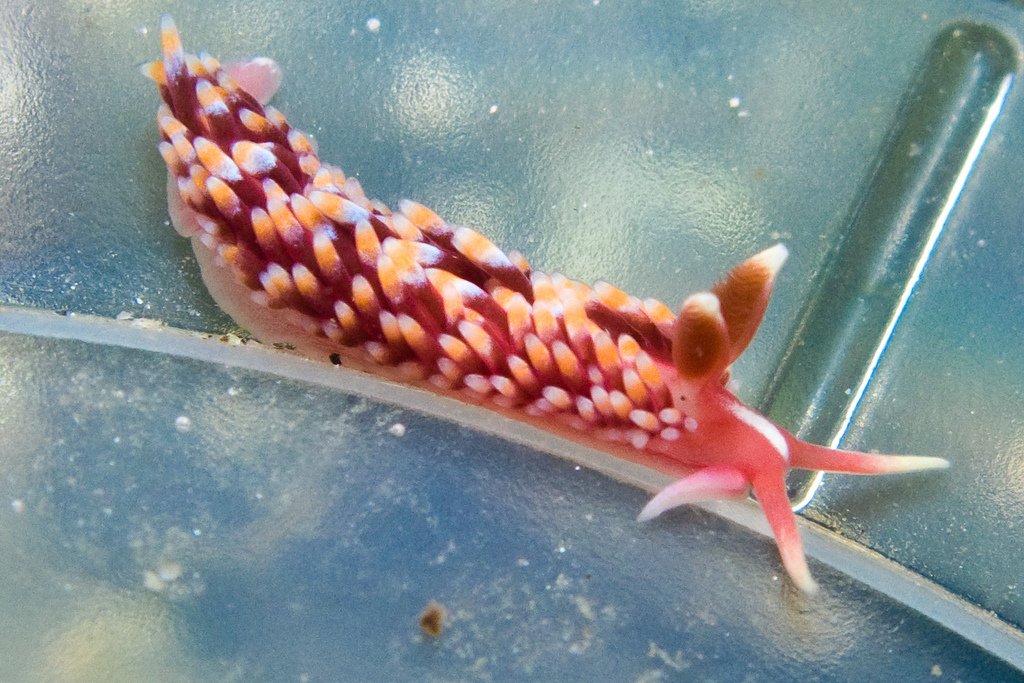
Babakina festiva is a nudibranch with a slender body and a trailing posterior edge of the foot. Its body is translucent, tinged with pink, purple, red or reddish-brown. It ranges in size from 10-32 mm long. The anterior corners of the foot are drawn out into oral tentacles. There is a white patch from the anterior edge of the head to the rhinophores (paired dorsal cephalic sensory structures). The cerata (dorsal and lateral club-like structures) are moderately long and taper distally. They do not extend well in advance of the rhinophores. The deep reddish-brown digestive gland extends into the cerata and is visible in the basal half of each ceras (singular of cerata). The upper parts of the cerata are opaque white, with a band of orange, ending in a white tip. The cerata are continuous with about 100 on each side of the body. The reddish-brown rhinophores arise from a single median stalk, so are Y-shaped. They are perfoliate (frond-like) and bear 34-43 leaf-like lamellae. Description from: Roller 1972; Behrens 1991; Gosliner et al. 2007; and McDonald 2007.
Gosliner (1990) and William Rudman (in Rudman 2006, Sea Slug Forum) suggested that the four known species of Babakina from the North Pacific, New Zealand, and Spain might be a single species transported around the world by ships. However, anatomical, phylogenetic (Gosliner 2007) and molecular analyses (Carmona et al. 2011) support their status as distinct species.
Taxonomy
Taxonomic Tree
| Kingdom: | Animalia | |
| Phylum: | Mollusca | |
| Class: | Gastropoda | |
| Subclass: | Opisthobranchia | |
| Order: | Nudibranchia | |
| Family: | Babakinidae | |
| Genus: | Babakina | |
| Species: | festiva |
Synonyms
Potentially Misidentified Species
Spain, Bahamas, Brazil (Gosliner et al. 2007)
Babakina caprinsulensis
New Zealand (Gosliner et al. 2007)
Babakina indopacifica
Philippines and Hawaii (Gosliner et al. 2007)
Ecology
General:
Babakina festiva is a nudibranch found in open coastal regions and rocky shores. Nudibranchs are simultaneous hermaphrodites, and copulate reciprocally or unilaterally. Specific details of reproduction are unknown for B. festiva. For nudibranchs, generally, eggs are laid in strings, ribbons, or masses attached to a hard substrate. Most Northeast Pacific nudibranchs hatch out as planktotrophic larvae, but some have lecithotrophic larvae (Barnes 1983; Goddard 2007).
Babakina festiva inhabits tidepools and shallow waters of rocky open coasts in warm-temperate regions. We have no specific information on the feeding of this nudibranch, but as a group, these slugs are carnivorous, feeding on attached organisms such as hydroids, bryozoans, tunicates, and on invetebrate eggs, including those of other nudibranchs (Barnes 1983).
Food:
hydroids (probably)
Trophic Status:
Carnivore
CarnHabitats
| General Habitat | Rocky | None |
| Salinity Range | Polyhaline | 18-30 PSU |
| Salinity Range | Euhaline | 30-40 PSU |
| Tidal Range | Subtidal | None |
| Tidal Range | Low Intertidal | None |
| Vertical Habitat | Epibenthic | None |
Tolerances and Life History Parameters
| Minimum Length (mm) | 10 | Gosliner et al. 2007 |
| Maximum Length (mm) | 35 | Gosliner et al. 2007 |
| Broad Temperature Range | None | warm-temperate |
| Broad Salinity Range | None | polyhaline-euhaline |
General Impacts
No impacts have been reported for Babakina festiva in North American waters.Regional Distribution Map
| Bioregion | Region Name | Year | Invasion Status | Population Status | Vectors |
|---|---|---|---|---|---|
| NEP-VI | Pt. Conception to Southern Baja California | 1968 | Crypogenic | Established | |
| NEP-VIII | None | 1975 | Crypogenic | Established | |
| NWP-4a | None | 1956 | Native | Established | |
| NWP-3a | None | 0 | Native | Established | |
| P022 | _CDA_P022 (San Diego) | 1968 | Crypogenic | Established | |
| P060 | Santa Monica Bay | 1971 | Crypogenic | Established | |
| NWP-3b | None | 0 | Native | Established | |
| P056 | _CDA_P056 (Los Angeles) | 1972 | Crypogenic | Established | |
| NEP-V | Northern California to Mid Channel Islands | 1987 | Crypogenic | Unknown | |
| P086 | _CDA_P086 (San Francisco Coastal South) | 1987 | Crypogenic | Unknown | |
| NWP-4b | None | 0 | Native | Established | |
| P095 | _CDA_P095 (Tomales-Drakes Bay) | 1988 | Crypogenic | Unknown | |
| NWP-2 | None | 0 | Native | Established | |
| P065 | _CDA_P065 (Santa Barbara Channel) | 2009 | Crypogenic | Established |
Occurrence Map
| OCC_ID | Author | Year | Date | Locality | Status | Latitude | Longitude |
|---|---|---|---|---|---|---|---|
| 32773 | Carlton 1979 | 1968 | 1968-01-01 | La Jolla | Crypogenic | 32.8479 | -117.2776 |
References
Barnes, Robert D. (1983) Invertebrate Zoology, Saunders, Philadelphia. Pp. 883Behrens, D.W. (1991) Pacific Coast Nudibranchs, In: (Eds.) . , Monterey, California. Pp. <missing location>
California Academy of Sciences 2005-2015 Invertebrate Zoology Collection Database. <missing URL>
Carlton, James T. (1979) History, biogeography, and ecology of the introduced marine and estuarine invertebrates of the Pacific Coast of North America., Ph.D. dissertation, University of California, Davis. Pp. 1-904
Carmona, Leila; Gosliner, Terrence M.; Pola, Marta; Cervera, Juan Lucas (2011) A molecular approach to the phylogenetic status of the aeolid genus Babakina Roller, 1973 (Nudibranchia), Journal of Molluscan Studies 77: 417-422
Goddard, Jeffrey H. R. (2007) The Light and Smith Manual: Intertidal Invertebrates from Central California to Oregon, University of California Press, Berkeley CA. Pp. 781-782
Gosliner, Terrence M. (1990) New records of two rare aeolid nudibranchs from the coast of California., Veliger 33(3): 321-322
Gosliner, Terrence M.; González-Duarte, Manuel M.; Cervera, Juan Lucas (2007) Revision of the systematics of Babakina Roller, 1973 (Mollusca: Opisthobranchia) with the description of a new species and a phylogenetic analysis, Journal of the Linnean Society of London 151: 671-689
McDonald, Gary R. (2007) The Light and Smith Manual: Intertidal Invertebrates from Central California to Oregon, University of California Press, Berkeley CA. Pp. 788-807
Miller, Michael D. 2004-2014 Slug Site. <missing URL>
Roller, Richard A. (1972) Three new species of eolid nudibranchs from the West Coast of North America, Veliger 14(4): 416-423
Roller, Richard A. (1973) Babakina, new name for Babaina 1972, preoccupied, Veliger 16: 117-18
Rudman, W. B. 1997-2016 Sea Slug Forum. http://www.seaslugforum.net/